Lord, you are just, and the judgements you make are right. Show mercy when you judge me, your servant.
Opening prayer (on Christian Freedom)
Let us pray that we may realise the freedom God has given us in making us his sons and daughters. God our Father, you redeem usand make us your children in Christ. Look upon us, give us true freedom and bring us to the inheritance you promised. Grant this through our Lord Jesus the Christ, your Son, who lives and reigns with you and the Holy Spirit, Our God, for ever and ever. Amen
or
Opening prayer (on the Appreciation of Life)
Let us pray to our Just and Merciful God. Lord Our God, in you Justice and Mercy meet. With unparalleled love you have saved us from death and drawn us into your Circle of Life. Open our eyes to the wonders this life sets before us, that we may serve you free from fear and address you as God Our Father. We ask this through Christ Our Lord. Amen.
First Reading: Is 35:4-7a
Psalm: 146
Second Reading: St. James 2:1-5
Gospel: Mark 7:31-37
Prayer over the Gifts:
God of peace and love, may our offering bring you true worship and make us one with you. Grant this through Christ Our Lord. Amen.
Communion Antiphon: John 8:12
I am the light of the world, says The Lord; the man who follows me will have the light of life.
The Opening Prayers introduce this week’s theological themes of freedom and life.
Difference between freedom and independence (2244f):
Freedom means that we have the ability to make choices and decisions; it is the exercising of free will.
Freedom does not mean that the individual is independent of the faith community or the State; the Catholic faith teaches that individuals exercise freedom when they practise their beliefs within their faith community and participate fully within the State.
Interdependence (2074;2239):
Interdependence is the goal of Christian community and Christian Socialism.
Interdependence is supported in both Scripture and the writings of the Church.
2236 The exercise of authority is meant to give outward expression to a just hierarchy of values in order to facilitate the exercise of freedom and responsibility by all. Those in authority should practise distributive justice wisely, taking account of the needs and contribution of each, with a view to harmony and peace. They should take care that the regulations and measures they adopt are not a source of temptation by setting personal interests against that of the community (Centesimus annus, 25).
Politics (2244-2257):
Political activity should be an opportunity for the individual to impact the State; political action however should not be seen as an opportunity for believers to proselytise or force faith on other members of the State. A believer who is active in politics should act on their beliefs and convictions, but should equally allow others the opportunity to act on their beliefs and religious convictions without interference from the State.
2237 Political authorities are obliged to respect the fundamental rights of the human person. They will dispense justice humanely by respecting the rights of everyone, especially of families and the disadvantaged. The political rights attached to citizenship can and should be granted according to the requirements of the common good. They cannot be suspended by public authorities without legitimate and proportionate reasons. Political rights are meant to be exercised for the common good of the nation and the human community.
This tells us that according to Catholic Theology and Social Teaching that a free, peaceful social order is the obligation of those in charge of the State. It also tells us that all citizens should be allowed to participate fully in the life of the State in the pursuit of the Common Good.
The selection from Isaiah has the Lord speaking to those in
When reading passages such as these, we must not forget that the authors had God promise safety and security for “His people”; this safety of the state was defensive in nature however. The state was to be strong and defensive, not offensive or “pre-emptive” in its military might.
The Responsorial Psalm tells us that God cares for the social order (2419-2463) and expects individuals to act in harmony towards achieving the common good. (1905-1927)
1. justice for the oppressed (1897-1927)
2. food for the hungry (2437-2463)
3. gives sight to the blind (healing/health) (2288-2296; 2301)
4. raise up those who were put down (2307-2330)
5. loves the “just” (1928-1948)
6. protects strangers (360f)
7. fatherless/widowed (less fortunate)(1889-1896)
The 2nd reading has to do with the wealthy not having preferential treatment by either State, Church/Temple or Community. We are called to have equal love for all of our brothers and sisters who form part of our communities – be they poor, middle class or rich. Catholic Socialism does not see the wealthy as having more power and prestige, but instead a greater responsibility – as they have the most to contribute to collectivism. Those in society who have many resources and connections are to share with those who do not.
After reading and reflecting on these scriptures and selections from the Catechism, it is good now to look at the actions of those in charge of the
The 9/11 anniversary is being used as an opportunity to spread fear and hate by the Administration, who are using the acts of a fundamentalist religious minority against civilians to justify curtailing the freedoms of those who live in America.
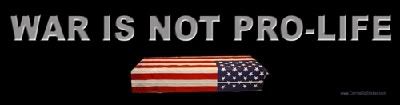
The Administration also acts against life by supporting interventionist wars and foreign policies that lead to deaths.
Let us move from fear, hatred and bigotry to true freedom and true life.