
Monday, August 20


Sunday, August 5
Religions for Peace
Here is a good article about how religion can be a force for peace and unity in the world:
For more information, please visit the homepage for the World Conference of Religions for Peace.
Waging peace in the name of religion
By Charles C. Haynes
08.05.07
Iraq, Sudan, Sri Lanka, Palestine. In a world torn by sectarian violence, religion is often seen as the problem, not the solution.
But an international coalition called Religions for Peace is working hard to change that perception by mobilizing religious leaders to fight back against those who use religion to promote violence.
Inter-religious dialogue is often dismissed (or overlooked) as a well-meaning but benign endeavor — certainly not risky or life-threatening. Hayder Karim knows better.
Karim, a 31-year-old Iraqi surgeon, was forced to leave his country this summer because he had the audacity to bring together Shiite and Sunni religious leaders in the cause of peace. As Iraq coordinator for Religions for Peace, he is no longer safe in Baghdad.
“Often I have expected death,” Karim wrote recently in The Washington Post, "my neighbors', my loved ones', my own."
In the wake of the U.S. invasion four years ago, Karim was treating patients round-the-clock (literally) on a worn-out sofa in a makeshift clinic located in a Sunni mosque. Son of a Shiite father and a Sunni mother, Karim was appalled and angered by those who exploited long-simmering sectarian differences to cause death and destruction.
Karim’s decision to work for peace by bringing together Iraqi religious leaders (the first such gathering took place in Amman, Jordan, in 2003) may seem naive. After all, the religious divisions plaguing the Middle East — among Muslims and between Muslims, Christians and Jews — are grounded in centuries of conflict and distrust.
But insurgent groups, sectarian militias and al-Qaida forces all understand the power of reconciliation across religious lines. That’s why Karim and anyone else who supports Religions for Peace in Iraq courts death.
Of course, the big question is: Does inter-religious cooperation make a difference? While it’s hard to measure “success” in the Sisyphean struggle against violent conflict, Religions for Peace has worked for more than 40 years to create grassroots alliances in local communities throughout the world. Today, the group supports multi-religious partnerships in some 55 nations.
This makes sense. Religious communities are the most prevalent and influential civil institutions in the world. With so much media attention focused on “religion the problem,” it’s easy to forget the daily efforts of countless religious groups to combat poverty, disease and war itself.
The idea is to focus religious groups on their shared struggle against the common enemies of humankind — and harness that energy for common action. Religions for Peace claims this works, citing successful inter-religious coalitions fighting such problems as violence against children, the HIV/AIDS pandemic and poverty — as well as helping to mediate conflicts in Africa, the Middle East and elsewhere.
Idealistic? Yes, but Hayder Karim will tell you that idealism is precisely what is most needed in places like Iraq. Until religious groups in Iraq and other war-torn nations find the will to work together to end the cycle of violence, no religious community — big or small — will be truly free.
It may be a long shot, but Religions for Peace deserves our support. Why not take a small fraction of what we spend waging war and invest it in winning the peace?
Charles C. Haynes is senior scholar at the:
First Amendment Center, 1101 Wilson Blvd., Arlington, Va. 22209.
Web: www.firstamendmentcenter.org.
E-mail: chaynes@freedomforum.org.
For more information, please visit the homepage for the World Conference of Religions for Peace.
Tuesday, July 31
Well, duh...
Lately it seems that in modern discourse there are only two possibilities when it comes to belief: atheism and Christianism. I am sooo sick of this mischaracterisation of faith and belief...
Anyway, the NYTimes (yeh, yeh, I know, *NYTs*) had an interesting article today that declares that even atheists can have belief in an afterlife. If this is new or shocking in any way, I must've missed something. I guess tomorrow they will have an article on how you can be an atheist and have faith - in Buddhism! ~~~shock!~~~ (I guess having a chest cold has made me even more sarcastic and silly than usual) Here is the article from the Times:
The original article can be found here.
Anyway, the NYTimes (yeh, yeh, I know, *NYTs*) had an interesting article today that declares that even atheists can have belief in an afterlife. If this is new or shocking in any way, I must've missed something. I guess tomorrow they will have an article on how you can be an atheist and have faith - in Buddhism! ~~~shock!~~~ (I guess having a chest cold has made me even more sarcastic and silly than usual) Here is the article from the Times:
If God is dead, does that mean we cannot survive our own deaths? Recent best-selling books against religion agree that immortality is a myth we ought to outgrow. But there are a few thinkers with unimpeachable scientific credentials who have been waving their arms and shouting: not so fast. Even without God, they say, we have reason to hope for — or possibly fear — an afterlife.
Curiously, the doctrine of immortality is more a pagan legacy than a religious one. The notion that each of us is essentially an immortal soul goes back to Plato. Whereas the body is a compound thing that eventually falls apart, Plato argued, the soul is simple and therefore imperishable. Contrast this view with that of the Bible. In the Old Testament there is little mention of an afterlife; the rewards and punishments invoked by Moses were to take place in this world, not the next one. Only near the beginning of the Christian era did one Jewish sect, the Pharisees, take the afterlife seriously, in the form of the resurrection of the body. The idea that “the dead shall be raised” was then brought into Christianity by St. Paul.
The Judeo-Christian version of immortality doesn’t work very well without God: who but a divine agent could miraculously reconstitute each of us after our death as a “spiritual body”? Plato’s version has no such need; since our platonic souls are simple and thus enduring, we are immortal by nature.
The Platonic picture may be pleasing, but it is hard to square with what we have learned from neuroscience. Everything that gives each of us our personal identities — consciousness, character, memories and so on — seems rooted in the electrochemical processes of our brains. As Bertrand Russell observed, “A virtuous person may be rendered vicious by encephalitis lethargica, and . . . a clever child can be turned into an idiot by a lack of iodine.” The dependence is most cruelly apparent in cases of Alzheimer’s disease, where the dissolution of the self proceeds in direct proportion to the physical deterioration of the brain.
Where does this leave those who, while secular in outlook, still pine after immortality? A little more than a century ago, the American philosopher William James proposed an interesting way of keeping open the door to an afterlife. We know that the mind depends on the physical brain, James said. But that doesn’t mean that our brain processes actually produce our mental life, as opposed to merely transmitting it. Perhaps, he conjectured, our brains allow our minds to filter through to this world from some transcendent “mother sea” of consciousness. Had James given his lecture a few decades later, he might have used the radio as a metaphor. When a radio is damaged, the music becomes distorted. When it is smashed, the music stops altogether. All the while, however, the signal is still out there, uncorrupted.
James’s idea of immortality may sound far-fetched, but for him and other scientifically minded thinkers of his time it had one great virtue. It explained the existence of what were thought to be psychic phenomena: ghostly apparitions, communications from the dead at séances and seeming cases of reincarnation. Alas, little of this supposed evidence for an afterlife has held up under the scrutiny of rigorous investigation.
In the 1970s, a new hope for survivalists emerged: the near-death experience. In the best-selling book “Life After Life,” a doctor and parapsychologist named Raymond A. Moody Jr. presented a number of cases in which patients who had flat-lined and then been revived told of entering a long tunnel and emerging into a dazzling pool of light, where they communed with departed loved ones. In 1988, the atheist philosopher A. J. Ayer had such an adventure when he choked on a piece of smoked salmon and his heart stopped for a few minutes. Soon afterward, Ayer reported that his near-death experience, in which he saw a red light that seemed to govern the universe, “slightly weakened my conviction that my genuine death . . . will be the end of me.” But he later dismissed it as a hallucination caused by a temporary lack of oxygen in his brain.
The most interesting possibilities for an afterlife proposed in recent years are based on hard science with a dash of speculation. In his 1994 book, “The Physics of Immortality,” Frank J. Tipler, a specialist in relativity theory at Tulane University, showed how future beings might, in their drive for total knowledge, “resurrect” us in the form of computer simulations. (If this seems implausible to you, think how close we are right now to “resurrecting” extinct species through knowledge of their genomes.) John Leslie, a Canadian who ranks as one of the world’s leading philosophers of cosmology, draws on quantum physics in his painstakingly argued new book, “Immortality Defended.” Each of us, Leslie submits, is immortal because our life patterns are but an aspect of an “existentially unified” cosmos that will persist after our death. Both Tipler and Leslie are, in different ways, heirs to the view of William James. The mind or “soul,” as they see it, consists of information, not matter. And one of the deepest principles of quantum theory, called “unitarity,” forbids the disappearance of information. (Stephen Hawking used to think you could destroy your information by heaving yourself into a black hole, but a few years ago he changed his mind.)
If death is not extinction, what might it be like? That’s a question the Harvard philosopher Robert Nozick, who died five years ago, enjoyed pondering. One of the more rococo possibilities he considered was that the dying person’s organized energy might bubble into a new universe created in that person’s image. Although his reflections were inconclusive, Nozick hit on a seductive maxim: first, imagine what form of immortality would be best; then live your life right now as though it were true. And, who knows, it may be true. “Life is a great surprise,” Vladimir Nabokov once observed. “I do not see why death should not be an even greater one.”
The original article can be found here.
Wednesday, July 18
The Economic Costs of the Bush Administration

Thomas F. Schaller, of the UMBC Political Science Department, wrote an article for the Baltimore Sun today that outlines what impact the Bush Administration is having on the American economy.
Despite decades of conservative emphasis on economic opportunity, Americans who work for a living aren't buying the "ownership society" and other presidential platitudes. Working people value "economic security" over "economic opportunity," 69 percent to 26 percent - and by security they mean health care reform and retirement security.
"Only 1 percent of Americans said the American dream means obtaining wealth," noted Ms. Lake, in direct rebuke to the familiar but false claims from conservatives that people think getting rich is the core of our national identity.
The American dream used to be simply stated: Work hard and you get ahead. But Americans are working harder than ever: Productivity is up, vacation time down. The fruits of their labor, though hardly spoiled, just don't taste as sweet.
Read the entire story here.
Schaller is the author of Whistling Past Dixie: how the Democrats can win without the South.
Vital Distinctions in Transplantation
Hospital Chaplains not only provide spiritual and emotional support to patients, staff and familes of all faiths - and none - but they also help patients, families and staff members to come to ethical decisions relating to the difficult life transitions of birth, life, death, organ donation, withdrawl of life support, and the decision to seek treatment (or not).
An article which explains the current Catholic ethical outlook follows.
For more on the definition of death in Catholic ethics:
Evangelium Vitae:
http://www.vatican.va/holy_father/john_paul_ii/encyclicals/documents/hf_jp-ii_enc_25031995_evangelium-vitae_en.html
(at Vatican official site)
http://www.ewtn.com/library/encyc/jp2evang.htm
(from EWTN Library)
Wikipedia Page on Evangelium Vitae
Wikipedia article on Culture of Life
The Culture of Life Top Ten
The law that George W. Bush signed as Govenor of Texas that allows for the euthanasia of patients by Doctors acting under "economic considerations". That is right: GEORGE BUSH ADVOCATES EUTHANASIA AND THE CULTURE OF DEATH.
1 Samuel 2:6
An article which explains the current Catholic ethical outlook follows.
Vital Distinctions in Transplantation
by Paul A. Byrne, MD
Organ and tissue donation can be divided into four general categories:
(1) A living person can give nonvital organs and tissues to another person without causing death, severe injury, or disabling mutilation to self. For example, one might give one of two kidneys, or bone marrow.
(2) Tissues including corneas, heart valves, bones, skin, ligaments and tendons can be taken after death—that is, after the heart is no longer beating and there is destruction of the vital systems, including circulatory, respiratory, and central nervous systems.
(3) Vital organs, such as the heart, liver, lungs, pancreas, and intestine, are harvested from persons declared "brain dead." Such persons are beating-heart "donors." Calling such living persons "Heart Beating Cadaver Donors" misleads the public and even members of the medical community. Can a cadaver have a beating heart and circulation?
(4) Organs are taken from "non-heart-beating donors (NHBD)." A NHBD is a living person with normal vital signs and a brain that is functioning. These persons are first taken off all life support, including the ventilator. When the pulse is no longer palpated, the organs are taken. After the organs are taken, the patient is dead. The public are continually misled. To stop a ventilator to get organs for another person is clearly an evil action.
The first two categories encompass organ and tissue donation that may constitute charitable acts, even commendable gifts of life. The latter, however, constitute a form of epivalothanasia ("imposed death") in which the "gift of life" is the immoral taking of the life of the "donor" through the excision of a vital organ or organs.
Note that organs are taken after a declaration of "brain death"—not after factual, true death, which is the end of natural life. The person from whom a beating heart is taken could well have been a person not very different from you and me. Most likely, he or she was able to walk and talk, but then something happened—possibly, brain injury from an accident, a stroke, or decreased oxygen to the brain. Now he or she is in an intensive care unit (ICU) and a ventilator is assisting breathing.
The ventilator—commonly mislabeled a "respirator"—is a machine that moves air into the lungs. It can be effective only if there are functioning respiratory and circulatory systems to add oxygen to the blood and carry the blood to and from the tissues of the body. The heart is beating; there is normal blood pressure. Intact internal organs and systems maintain the unity of the body. When a light is shined into the eye, the pupil response is not seen. When ice water is put into the ear, there is no response. No cough or gag would be observed. Other brain stem reflexes might be evaluated. A neurologist makes a declaration of "brain death" using one of many different sets of criteria. The neurologist or hospital can use any of these divergent sets. Thus, a person could be declared "brain dead" if one set is used, but not be declared "brain dead" if another set was employed.
Every set of criteria for "brain death" includes an apnea test. ("Apnea" means the absence of breathing.) This test, which has no benefit for the comatose patient and, in fact, aggravates the patient's condition, is done without the knowledge or consent of family members. The apnea test, during which the ventilator is turned off for up to 10 minutes, can induce "brain death" or cardiac arrest. Its sole purpose is to determine the patient's inability to breathe on his own in order to declare "brain death."
When patients declared "brain dead" are treated, instead of having their beating hearts cut out, they can continue to live. Pregnant women have given birth months after having been declared "brain dead." Thus, the editor of the Journal of the American Medical Association wrote,
Now we are told a brain dead patient can nurture a child in the womb, which permits live birth several weeks "post-mortem." Perhaps this is the straw that breaks the conceptual camel's back. Death of the brain seems not to serve as a boundary; it is a tragic ultimately fatal loss, but not death itself.
In the case of transplantation, after "brain death" has been declared, the ventilator and other life support are continued until it is convenient to harvest the "donor's" organs. Everyone present can witness the intact circulatory system via the beeping of the heart monitor and the visual display of the signals from the beating heart, as well as the recordable blood pressure. The intact respiratory system is manifest through the normal color of the skin. The exchange of oxygen and carbon dioxide can be verified by determining blood gasses (pH, pCO2, and pO2). The intact interdependence of circulatory and respiratory systems can be readily observed by applying pressure to the skin, resulting in blanching, which will be followed by return of normal color within a few seconds after removal of the pressure. Through more sophisticated means, an intact endocrine system (pituitary, thyroid, and adrenal hormone production) can be demonstrated. An intact functioning liver can be documented through laboratory tests.
Clearly, there are many signs present in "brain dead" patients, including vital signs that physicians and laymen are accustomed to associate with being alive. After the beating heart is excised, however, findings more commonly identified with the fact of death—that is, no circulation or breathing—can be observed. Deprived of organs needed to sustain life, the "donor" will be cold, blue, pale, and stiff—in short, dead.
Are we not being asked to accept two medically distinguishable situations as legally equivalent? To say that a patient with a beating heart, normal pulse, normal blood pressure, normal color, and normal temperature is "dead" is a lie. The force of law will not make it true.
Great care must be taken not to declare a person dead even one moment before death has occurred. Death should be declared only after, not before, the fact. To declare death prematurely is to commit a fundamental injustice. A person is living even a moment before death and must be treated as such. Every time a heart is taken for transplant, it is a beating heart that is stopped by the surgeon just prior to excision. It takes about an hour of surgery to remove the heart. During this time, it is common for the so-called "donor" to be given a paralyzing drug, but not an anesthetic. It has been reported that when the incision is made to take the organs, there is an increase in heart rate and blood pressure. Could this occur if the person were dead? The answer is no. A doctor or other medical personnel must never impose death on a patient.
It is easy to move one's emotions with images of organ recipients resuming "normal lives" after they have received a heart, but what about the life of the donor? Was the donor in fact dead? If there is any doubt about the fact of death, may one rightfully carry out an action that will impose death on another? Who sheds tears for the victims of utilitarian euthanasia?
It is wrong to impose death on an innocent human being and to participate in its imposition. Likewise, we should not encourage others to participate in organ transplantation unless all doubts about death have been removed. Everyone getting a driver's license ought to be informed of the truth about "brain death" and organ transplantation before answering the question "Do you want to be an organ donor?" After all, your life may well depend on your answer.
Dr. Paul A. Byrne, a Neonatologist, is Director of Neonatology and Director of Pediatrics at St. Charles Mercy Hospital in Oregon, Ohio, is Clinical Professor of Pediatrics University of Toledo College of Medicine, Board Certified in Pediatrics and Neonatal-Perinatal Medicine, Member of Fellowship of Catholic Scholars.
Dr. Byrne is past-President of the Catholic Medical Association (USA), formerly Clinical Professor of Pediatrics at Creighton University School of Medicine in Omaha, NE, and at St. Louis University School of Medicine in St. Louis, MO. He is author and producer of the film "Continuum of Life" and author of the books "Life, Life Support and Death," "Beyond Brain Death," and "Brain Death Is Not Death."
Dr. Byrne has presented testimony on "life issues" to eight state legislatures beginning in 1967. He opposed Dr. Kevorkian on the television program "Cross-Fire." He has been interviewed on Good Morning America, public television in Japan and participated in the British Broadcasting Corporation Documentary "Are the Donors Really Dead?" Dr. Byrne has authored articles against euthanasia, abortion, and "brain death" in medical journals, law literature and lay press.
Paul was married to Shirley for forty-eight years until she entered her eternal reward on Christmas 2005. They are the proud parents of twelve children and grandparents of twenty-six grandchildren.
http://www.catholicculture.org/library/view.cfm?recnum=7656
This item 7656 digitally provided courtesy of CatholicCulture.org
For more on the definition of death in Catholic ethics:
Evangelium Vitae:
http://www.vatican.va/holy_father/john_paul_ii/encyclicals/documents/hf_jp-ii_enc_25031995_evangelium-vitae_en.html
(at Vatican official site)
http://www.ewtn.com/library/encyc/jp2evang.htm
(from EWTN Library)
Wikipedia Page on Evangelium Vitae
Wikipedia article on Culture of Life
The Culture of Life Top Ten
The law that George W. Bush signed as Govenor of Texas that allows for the euthanasia of patients by Doctors acting under "economic considerations". That is right: GEORGE BUSH ADVOCATES EUTHANASIA AND THE CULTURE OF DEATH.
(For those of you who think that this doesn't affect you because you live outside of Texas, you have "good insurance", or are wealthy, understand this: so far the cases that have been affected by this law have involved patients who were unable to continue/maintain medical treatment due to monetary concerns. The problem is that there have been cases where patients who were conscious and responsive were taken off of ventilators by doctors and medical staff against patient and family wishes and forced to die. This is a violation of medical ethics and the right of individuals to have equal standing in society despite financial value. Currently this only affects those who "are beyond medical hope" or "unable to bear the financial responsibility of treatment"... but these laws are making it possible for Doctors and Insurance Companies to play God.
Another disturbing consequence of George Bush's law is that physicians and hospitals are given immune from civil or legal actions being taken against them under the law as long as it can be shown that they acted "reasonably". Do you trust lawyers, politicans and medical staff to act more justly and rightly than the Lord?
1 Samuel 2:6
"The LORD brings death and makes alive;
he brings down to the grave and raises up.
Monday, July 16
Our Lady of Mount Carmel, July 16, 2007

Collect:
Father, may the prayers of the Virgin Mary protect us and help us to reach Christ her Son who lives and reigns with you and the Holy Spirit, one God, forever and ever.
Amen.
First Reading: Exodus 1:8-14, 22
Psalm: Psalm 124:1-8
Gospel: Matthew 10:34 -- 11:1
What Revelation makes known to us is confirmed by our own experience. For when man looks into his own heart he finds that he is drawn towards what is wrong and sunk in many evils which cannot come from his good Creator. Often refusing to acknowledge God as his source, man has also upset the relationship which should link him to his last end, and at the same time he has broken the right order that should reign within himself as well as between himself and other men and all creatures.
-- Gaudium et spes
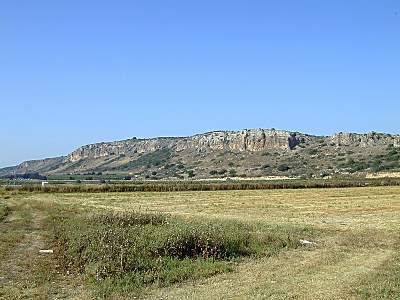
A picture of Mt. Carmel from BiblePlaces.com
History and Promises of Our Lady of Mount Carmel:
Sacred Scripture celebrates the beauty of Mount Carmel, where the prophet Elijah defended the purity of Israel's faith in the living God.
In the early centuries of the Current Era, Christian hermits withdrew to the area around the base of (and even on the slopes of) Mount Carmel to live out a simple life dedicated to Christ. Eventually, so many pius individuals had congregated in the area, that it was no longer able for them to live in seclusion as hermits; in the mid-12th Century, the Carmelite Order, which is devoted to living the contemplative life in community with other Brothers or Nuns in seclusion from the world was established. The community is under the patronage of Mary, the holy Theotokos.
Our Blessed Mother appeared to St. Simon Stock (the General of the Holy Order of Carmelites) on July 16, 1251. During the apparition, Mary gave him the Brown Scapular and said: "This will be for you and for all Carmelites the privilege, that he who dies in this will not suffer eternal fire."
The feast of Our Lady of Mount Carmel was instituted by the Carmelites on July 16th, 1332, and extended to the whole Church by Benedict XIII in 1726.
Even today, the devotion to Our Lady of Mount Carmel has spread through the entire world and all cultural, social and economic groups. Most modern "practising" Catholics are familiar with the Scapular of Our Lady of Mount Carmel (the Brown Scapular) even if it is just because they remember recievning one at their First Communion.
The conditions of the Sabbatine Privilege are:
1. Wear the Brown Scapular faithfully and constantly.
2. Observe chastitiy according to your particular state in life.
3. Recite the Little Office of the BVM daily, or with the permission of your Priest, you may substitute another pious work - such as saying the Rosary, the Divine Mercy Chaplet, praying the Psalms, Study of Holy Scriptures and writings,and Lectio Divina - for this daily Spiritual Exercise.
*Any* Priest who can hear Confessions (and that is most Priests!) can enroll you in the Society of the Brown Scapular, as well as help you develop the particular devotional that you will use for the third condition.
From CatholicCulture.org:
Things to Do:
* If you have not already done so, have a priest enroll you in the Scapular of Our Lady of Mount Carmel, or popularly known as the "Brown Scapular" and begin wearing it as a sign of your love for Our Lady. A priest enrolls people in the Brown Scapular only once. The Scapular can then be replaced afterwards by other scapulars or the scapular medal, which has on one side the image of the Sacred Heart of Jesus and on the other, the image of Mary. The medal needs to be blessed by a priest, but the cloth scapulars do not require a blessing (separate from enrollment).
* Wearing the Brown Scapular is not an automatic guarantee of salvation. It is not a magical charm, nor is it an excuse to live in a way contrary to the teachings of the Church. It is a sacramental which has been approved by the Church for over seven centuries and is a sign of one's decision to follow Jesus as did Mary, the perfect model of all the disciples of Christ. In addition to being an introduction into the Family of Carmel, the Brown Scapular is an expression of our belief that we will meet God in eternal life, aided by the intercession and prayer of Mary. While sacramentals prepare us to receive grace if we are in the right disposition, the Church emphasizes that only sacraments can confer sanctifying grace. (see Catechism, no. 1670.)
* Periodically the Church reexamines devotions and popular piety to make sure they are "not at odds with the centrality of the Sacred Liturgy. Rather, in promoting the faith of the people, who regard popular piety as a natural religious expression, they predispose the people for the celebration of the Sacred Mysteries" (John Paul II, September 2001). In accordance with Vatican II, the Congregation for Divine Worship and the Discipline of the Sacraments issued the Directory on Popular Piety in 2001 to reevaluate different devotions and popular piety. Though the Brown Scapular is included in the document as a wonderful pious practice, the Directory does not mention the Sabbatine Privilege, which continues to present historical difficulties. The Directory rather emphasizes the beautiful sign of the "filial relationship" with the faithful and Mary:
The history of Marian piety also includes "devotion" to various scapulars, the most common of which is devotion to the Scapular of Our Lady of Mount Carmel. Its use is truly universal and, undoubtedly, it is one of those pious practices which the Council described as "recommended by the Magisterium throughout the centuries."
The Scapular of Mount Carmel is a reduced form of the religious habit of the Order of the Friars of the Blessed Virgin of Mount Carmel. Its use is very diffuse and often independent of the life and spirituality of the Carmelite family.
The Scapular is an external sign of the filial relationship established between the Blessed Virgin Mary, Mother and Queen of Mount Carmel, and the faithful who entrust themselves totally to her protection, who have recourse to her maternal intercession, who are mindful of the primacy of the spiritual life and the need for prayer.
The Scapular is imposed by a special rite of the Church which describes it as "a reminder that in Baptism we have been clothed in Christ, with the assistance of the Blessed Virgin Mary, solicitous for our conformation to the Word Incarnate, to the praise of the Trinity, we may come to our heavenly home wearing our nuptial garb."
The imposition of the Scapular should be celebrated with "the seriousness of its origins. It should not be improvised. The Scapular should be imposed following a period of preparation during which the faithful are made aware of the nature and ends of the association they are about to join and of the obligations they assume."
* Pope John Paul II wore the scapular for a long time. The Holy Father's talk on The Scapular of Carmel, A Treasure for the Church mentions:
Therefore two truths are evoked by the sign of the Scapular: on the one hand, the constant protection of the Blessed Virgin, not only on life's journey, but also at the moment of passing into the fullness of eternal glory; on the other, the awareness that devotion to her cannot be limited to prayers and tributes in her honor on certain occasions, but must become a "habit", that is, a permanent orientation of one's own Christian conduct, woven of prayer and interior life, through frequent reception of the sacraments and the concrete practice of the spiritual and corporal works of mercy. In this way the Scapular becomes a sign of the "covenant" and reciprocal communion between Mary and the faithful: indeed, it concretely translates the gift of his Mother, which Jesus gave on the Cross to John and, through him, to all of us, and the entrustment of the beloved Apostle and of us to her, who became our spiritual Mother.
* For the definitive treatment on the brown scapular, read The Scapular of Our Lady of Mount Carmel: Catechesis and Ritual.
* The Blessed Virgin's scapular should remind us that Christians have an apostolate against current extremes and extravagances in modes of dress. Clothes are a symbol of the person. Like the Christian heart, dress must be chaste and simple, for one judges the interior from the exterior. It should not be necessary to add that special attention be given this matter when preparing for church attendance. Examine yourself on how well you reflect Christian modesty in your dress and if you are a parent, how well you ensure that your children are modestly dressed.
* In New York City in East Harlem is one of the oldest festivals in America for Our Lady of Mount Carmel. See Our Lady of Mount Carmel Shrine of East Harlem -- since 1881. In Brooklyn, New York, there is an annual festival for Our Lady of Mount Carmel. Find out more about the tradition of the Giglio Feast. Also look around your area for Italian parishes, maybe one named after Our Lady of Mount Carmel? Many times the parish will host wonderful festivals in her honor.
* From the Catholic Culture library, the Scapular Devotion, a description of Different Kinds of Scapulars, The Brown Scapular and information on the Scapular Medal.
* Learn more about St. Simon Stock and the Brown Scapular.
It's never too late to start a Novena to Our Lady of Mt. Carmel!
More information on :
The different kinds of Scapulars in use in the Catholic Church.
The Carmelites and the Brown Scapular
The Wikipepdia Article about Our Lady of Mt. Carmel
Apparently the Netherlands doesn't have freedom of religion...
... or the "Freedom Party" wants to take it away.
The AP reports:
I just think that it is terribly ironic that a group/coalition/party that calls itself the "Freedom Party" wants to take away the basic right of human beings to worship God as they see him. Instead of encouraging Muslim women and men to "integrate themselves into Dutch society", measures such as this will only make them more culturally and religiously distrustful and insular.
If Mr. Geert Wilders is a Christian, I pray that he will take the time to read what happened when another goverment (Rome) tried to suppress the culture, faith and social structure of another religion (Christianity) in the first couple of centuries of the Christian era. The suppression, oppression, and martyrdom of the Early Christian Church only served in its spread (in additon to its Teachings and Truth) throughout the Roman Empire.
The AP reports:
The Associated Press
THE HAGUE, Netherlands
A right-wing Dutch lawmaker wants women jailed for wearing the head-to-toe Islamic robe known as a burqa, calling it a "symbol of oppression."
Geert Wilders, whose Freedom Party has nine lawmakers in the 150-seat lower house of Dutch parliament, filed a proposal Thursday to make wearing a burqa in public a crime punishable by up to 12 days jail.
"The burqa and niqab are a symbol of oppression of women," Wilders told The Associated Press in a telephone interview. He said burqas and the niqab _ a full-faced veil with only a slit for the eyes _ hindered integration of Muslim women into Dutch society and also posed a security risk.
An Islamic community spokesman, Ayhan Tonca, called Wilders' proposal "totally out of proportion" and accused him of seeking to broaden a rift between Muslims and the rest of Dutch society.
Last November, the Dutch government said it was drawing up legislation to ban burqas, but that administration was defeated in elections the same month. The new centrist coalition of Prime Minister Jan Peter Balkenende has no plans to implement a burqa ban, meaning Wilders' proposal has little chance of becoming law.
Few women wear the burqa in the Netherlands, but the debate over whether to outlaw it underscores a drift away from traditional Dutch tolerance and unease with the growing influence of Islam in the country. About 6 percent of the Dutch population of 16 million is Muslim.
I just think that it is terribly ironic that a group/coalition/party that calls itself the "Freedom Party" wants to take away the basic right of human beings to worship God as they see him. Instead of encouraging Muslim women and men to "integrate themselves into Dutch society", measures such as this will only make them more culturally and religiously distrustful and insular.
If Mr. Geert Wilders is a Christian, I pray that he will take the time to read what happened when another goverment (Rome) tried to suppress the culture, faith and social structure of another religion (Christianity) in the first couple of centuries of the Christian era. The suppression, oppression, and martyrdom of the Early Christian Church only served in its spread (in additon to its Teachings and Truth) throughout the Roman Empire.
The blood of the martyrs is the seed of the church.
--Tertullian
Sunday, July 15
Fifteenth Sunday of Ordinary Time « July 15, 2007 »

Who is my neighbour?
First Reading: Deuteronomy 30:10-14
Psalm: Psalm 69:14, 17, 30-31, 33-34, 36-37 or Psalm 19:8-11
Second Reading: Colossians 1:15-20
Gospel: Luke 10:25-37
No one really wants to sin against God, even though we do all sin without being forced to do so.
-- St. John Climacus
Prayer for Social Justice
Lord Jesus, carpenter and king, supreme sovereign of all men, look with tender mercy upon the multitudes of our day who bear the indignities of injustice everywhere. Raise up leaders in every land dedicated to Your standards of order, equity, and justice. Grant unto us, Lord Jesus, the grace to be worthy members of Your mystical body, laboring unceasingly to fulfill our vocation in the social apostolate of Your Church. Sharpen our intellects to pierce the pettiness of prejudice; to perceive the beauty of true human brotherhood. Guide our minds to a meaningful understanding of the problems of the poor, of the oppressed, of the unemployed, of all in need of assistance anywhere. Guide our hearts against the subtle lure of earthly things and undue regard for those who possess them. May we hunger and thirst after justice always.
Amen
Prayer Source: Catholic Prayer Book by Fr. John A. Hardon, S.J., Eternal Life, February 15, 1999
This week's Lectio Divina
Wednesday, July 11
Memorial of St. Benedict, Abbot (Wednesday, July 11, 2007 )
Modern Calendar - St. Benedict, abbot
Old Calendar - St. Pius I, pope and martyr

Saint of the Day :
First Reading: Genesis 41:55-57; 42:5-7, 17-24
Psalm: Psalm 33:2-3, 10-11, 18-19
Gospel: Matthew 10:1-7
There is no repentance for the angels after their fall, just as there is no repentance for men after death.
-- St. John Damascene, De fide orthodoxa. 2, 4

Old Calendar - St. Pius I, pope and martyr
Saint of the Day :
First Reading: Genesis 41:55-57; 42:5-7, 17-24
Psalm: Psalm 33:2-3, 10-11, 18-19
Gospel: Matthew 10:1-7
There is no repentance for the angels after their fall, just as there is no repentance for men after death.
-- St. John Damascene, De fide orthodoxa. 2, 4
Tuesday, July 10
Tuesday of the Fourteenth Week of Ordinary Time
Saint of the Day:
Old Calendar - Seven Holy Brothers, martyrs and
Sts. Rufina and Secunda, virgins and martyrs
Modern Calendar - St. Veronica Giuliani, Virgin, Incorruptible (Feast)

First Reading: 2 Corinthians 4:6-11, 16, 17
Psalm: Psalm 59:2, 10, 17-18
Gospel: Matthew 16:24-27
Old Calendar - Seven Holy Brothers, martyrs and
Sts. Rufina and Secunda, virgins and martyrs
Modern Calendar - St. Veronica Giuliani, Virgin, Incorruptible (Feast)
First Reading: 2 Corinthians 4:6-11, 16, 17
Psalm: Psalm 59:2, 10, 17-18
Gospel: Matthew 16:24-27
In the same way a powerful medicine cures an illness, so illness itself is a medicine to cure passion. And there is much profit of soul in bearing illness quietly and giving thanks to God.
-- St. Amma Syncletice
Monday, July 9
Monday, July 9, 2007 (Feria)
(Optional Memorial of St. Augustine Zhao Rong, priest and companions, Chinese martyrs)

First Reading: Genesis 28:10-22
Psalm: Psalm 91:1-4, 14-15
Gospel: Matthew 9:18-26

First Reading: Genesis 28:10-22
Psalm: Psalm 91:1-4, 14-15
Gospel: Matthew 9:18-26
God is seen by those who have the capacity to see him, provided that they keep the eyes of their mind open. All have eyes, but some have eyes that are shrouded in darkness, unable to see the light of the sun. Because the blind cannot see it, it does not follow that the sun does not shine. The blind must trace the cause back to themselves and their eyes. In the same way, you have eyes in your mind that are shrouded in darkness because of your sins and evil deeds. No one who has sin within him can see God. If you understand this, and live in purity and holiness and justice, you may see God.
-- Saint Theophilus of Antioch
Sunday, July 8
If Space Invaders were People in a Theatre...
This is what the classic video game "Space Invaders" would look like if a Theatre was the vid screen:
They have a whole bunch of "__________ in Real Life" vids that are funny and cool on this YouTube page.
They have a whole bunch of "__________ in Real Life" vids that are funny and cool on this YouTube page.
Two Random Vids...
Here are two vids that I am currently enjoying on YouTube:
and
It's a Series of Tubes! (The Internets I mean!)
and
Heck No! I'll Never Listen to Techno! (a music video made using a Lite Brite for stop motion animation!)
Fourteenth Sunday of Ordinary Time

First Reading (Isaiah 66: 10 - 14) :
10 "Rejoice with Jerusalem, and be glad for her, all you who love her; rejoice with her in joy, all you who mourn over her;
11 that you may suck and be satisfied with her consoling breasts; that you may drink deeply with delight from the abundance of her glory."
12 For thus says the LORD: "Behold, I will extend prosperity to her like a river, and the wealth of the nations like an overflowing stream; and you shall suck, you shall be carried upon her hip, and dandled upon her knees.
13 As one whom his mother comforts, so I will comfort you; you shall be comforted in Jerusalem.
14 You shall see, and your heart shall rejoice; your bones shall flourish like the grass; and it shall be known that the hand of the LORD is with his servants, and his indignation is against his enemies.
-----------------------------------------------------------------------------------
The Second Reading (Galatians 6: 14 - 18) :
14 But far be it from me to glory except in the cross of our Lord Jesus Christ, by which the world has been crucified to me, and I to the world.
15 For neither circumcision counts for anything, nor uncircumcision, but a new creation.
16 Peace and mercy be upon all who walk by this rule, upon the Israel of God.
17 Henceforth let no man trouble me; for I bear on my body the marks of Jesus.
18 The grace of our Lord Jesus Christ be with your spirit, brethren. Amen.
-----------------------------------------------------------------------------------
The Psalm (Psalm 66: 1 - 7, 16, 20) :
1 Make a joyful noise to God, all the earth;
2 sing the glory of his name; give to him glorious praise!
3 Say to God, "How terrible are thy deeds! So great is thy power that thy enemies cringe before thee.
4 All the earth worships thee; they sing praises to thee, sing praises to thy name." [Selah]
5 Come and see what God has done: he is terrible in his deeds among men.
6 He turned the sea into dry land; men passed through the river on foot. There did we rejoice in him,
7 who rules by his might for ever, whose eyes keep watch on the nations -- let not the rebellious exalt themselves. [Selah]
16 Come and hear, all you who fear God, and I will tell what he has done for me.
20 Blessed be God, because he has not rejected my prayer or removed his steadfast love from me!
-----------------------------------------------------------------------------------
The Gospel (Luke 10: 1 - 12, 17 - 20):
1 After this the Lord appointed seventy others, and sent them on ahead of him, two by two, into every town and place where he himself was about to come.
2 And he said to them, "The harvest is plentiful, but the laborers are few; pray therefore the Lord of the harvest to send out laborers into his harvest.
3 Go your way; behold, I send you out as lambs in the midst of wolves.
4 Carry no purse, no bag, no sandals; and salute no one on the road.
5 Whatever house you enter, first say, `Peace be to this house!'
6 And if a son of peace is there, your peace shall rest upon him; but if not, it shall return to you.
7 And remain in the same house, eating and drinking what they provide, for the laborer deserves his wages; do not go from house to house.
8 Whenever you enter a town and they receive you, eat what is set before you;
9 heal the sick in it and say to them, `The kingdom of God has come near to you.'
10 But whenever you enter a town and they do not receive you, go into its streets and say,
11 `Even the dust of your town that clings to our feet, we wipe off against you; nevertheless know this, that the kingdom of God has come near.'
12 I tell you, it shall be more tolerable on that day for Sodom than for that town.
17 The seventy returned with joy, saying, "Lord, even the demons are subject to us in your name!"
18 And he said to them, "I saw Satan fall like lightning from heaven.
19 Behold, I have given you authority to tread upon serpents and scorpions, and over all the power of the enemy; and nothing shall hurt you.
20 Nevertheless do not rejoice in this, that the spirits are subject to you; but rejoice that your names are written in heaven."

Saturday, July 7
Catholic News for the Thirteenth Week of Ordinary Time
Pope Benedict XVI has "dropped restrictions on using the 1962 Latin Mass"
CBSNews.com reports:
Catholic World News reports:
This second story sounds much more positive in tone and conveys the tone that Benedict sets in his apostolic letter.
The CWN story also gives an explination of the background history that has made this motu proprio necessarry on the part of the Holy See.
The USCCB has published a newsletter for American parishoners to explain this motu proprio through catechesis that includes both the papal documents themselves and a FAQ about the new norms and the "extraordinary form" of the liturgy.
For those of us who prefer to read in German, kath.net has posted the entirety of Benedict XVI's letter online.

Pope Benedict XVI has announced his Prayer Intentions for July:
His mission intention for the month of July is:

The Catholic Church in China is still suffering difficulty and persecution from the Government:
On the first of July, Benedict XVI issued a letter Calling for ecclesial unity in China, while urging Communion among all Bishops.
In "Letter of the Holy Father Benedict XVI to the Bishops, Priests, Consecrated Persons and Lay Faithful of the Catholic Church in the People's Republic of China", Benedict XVI called for unity and reconciliation for the Church in China.
The letter, was signed by the Pope on May 27th, which marks the Solemnity of Pentecost on the Church Calendar. Benedict spoke of the Vatican's openness to dialogue with government officials in China while emphasizing that The Holy See "does not want to interfere in the affairs of the political community" (i.e. the Communist/Totalitarian State).
The Political Church established by the Communist Party (The Chinese Patriotic Catholic Association) does recognises neither the Holy See nor the Magisterium of the Church. The CPCA has been appointing its own PC "Bishops" to perform the work of Bishops - trying to remove the authority of the Pope to appoint Bishoprics.
The entire text of the letter, which is titled "LETTER OF THE HOLY FATHER POPE BENEDICT XVI TO THE BISHOPS, PRIESTS, CONSECRATED PERSONS AND LAY FAITHFUL OF THE CATHOLIC CHURCH IN THE PEOPLE'S REPUBLIC OF CHINA", maybe found online here.
On the 1st of July, the Goverment of China responded to the Pope's letter:
In order to help Catholic faithful understand the Papal letter, and the history of the Catholic Church in China over the last 150 years, Benedict issued an Explanitory Note on the Pastoral Letter to the Church in China.
The complete text of the explanitory note can be found here.
Despite the assurances given to the Vatican and Magesterium that the Chinese Government supports the political, social, and religious rights of its citizens, the Chinese Goverment is doing all that it can to supress the Letter from the Holy See.
Catholic News reports:
After the release of the letter, Father Federico Lombardi, director of the Holy See's Press Office, said that Pope Benedict XVI's letter to Chinese Catholics "is motivated by two great loves: his love for China and his love for the Catholic Church."
On July 1st Cardinal Joseph Zen Ze-kiun, Bishop of Hong Kong, took part in a pro-democracy demonstration marking the 10th anniversary of the city's return to China.
The CPCA responded to the Criticisms of Cardinal Zen as well as the letter from Benedict XVI by issuing the following statements:
The USCCB criticised American politicians for not effecting true immigration reform:
Bendict, in a message to the Bishops of Puerto Rico, stated that:
A group of seventy-five people which included teachers, parents, pricinpals, and students picketed the NEA convention in Philadelphia July 1. The protest was intended to bring awareness to the members of the NEA who are either ignorant of or in denial about the NEA's Family Planning Resolution, which supports "reproductive freedom" and "all methods of family planning" - including abortion. Most of the union members are also not aware that the NEA is one of Planned Parenthood's primary advocates (financially and through volunteer action). The auppport of PP by the NEA extends to the fact that the union has co-sponsored large pro-abortion rallies in Washington in 2004, 1992, and 1989.
Benedict XVI used the conclusion of his general audience on July 4th to address young people who are currently preparing for the next World Youth Day (WYD), due to be held in July 2008 in Sydney, Australia. The Holy Father encouraged the young people to:
CWN reports that:
Finally, the Catholic news from Iraq continues to worsen:
CBSNews.com reports:
In a major gesture to traditional, conservative Roman Catholics, PopeBenedict XVI on Saturday removed restrictions on celebrating the old Latin Mass, reviving a rite that was all but swept away by the liberalizing reforms of the Second Vatican Council.
Catholic World News reports:
With a motu proprio entitled Summorum Pontificum, made public on July 7, Pope Benedict XVI (bio - news) has provided for a much broader use of the Roman Missal of 1962, explaining that he hopes to encourage "interior reconciliation in the heart of the Church."
The long-awaited motu proprio, which had been the subject of intensive speculation within the Church for more than a year, gives every priest the right to celebrate the Mass using the 1962 Missal, and instructs pastors to "willingly accept" requests from the faithful for access to the older liturgical form.
This second story sounds much more positive in tone and conveys the tone that Benedict sets in his apostolic letter.
The CWN story also gives an explination of the background history that has made this motu proprio necessarry on the part of the Holy See.
The USCCB has published a newsletter for American parishoners to explain this motu proprio through catechesis that includes both the papal documents themselves and a FAQ about the new norms and the "extraordinary form" of the liturgy.
For those of us who prefer to read in German, kath.net has posted the entirety of Benedict XVI's letter online.
Cardinal Friedrich Wetter, Archbishop Emeritus of Munich and Freising, Germany, has been appointed "Special Papal Envoy to Celebrations To Mark The Millennium Of The Archdiocese of Bamberg, Germany" by Benedict XVI. The Pope appointed Cardinal Wetter to head up the Celebration to be held on July 8 (along with the help of Fr. Gerhard Forch, Pastor of the Cathedral, and Msgr. Michael Hofmann, pastor of the parish of Allerheiligen in Nuremberg.
Pope Benedict XVI has announced his Prayer Intentions for July:
"That all citizens, individually and in groups, may be enabled to participate actively in the life and management of the common good."
His mission intention for the month of July is:
"That, aware of their own missionary duty, all Christians may actively help all those engaged in the evangelization of peoples."
The Catholic Church in China is still suffering difficulty and persecution from the Government:
On the first of July, Benedict XVI issued a letter Calling for ecclesial unity in China, while urging Communion among all Bishops.
In "Letter of the Holy Father Benedict XVI to the Bishops, Priests, Consecrated Persons and Lay Faithful of the Catholic Church in the People's Republic of China", Benedict XVI called for unity and reconciliation for the Church in China.
The letter, was signed by the Pope on May 27th, which marks the Solemnity of Pentecost on the Church Calendar. Benedict spoke of the Vatican's openness to dialogue with government officials in China while emphasizing that The Holy See "does not want to interfere in the affairs of the political community" (i.e. the Communist/Totalitarian State).
The Political Church established by the Communist Party (The Chinese Patriotic Catholic Association) does recognises neither the Holy See nor the Magisterium of the Church. The CPCA has been appointing its own PC "Bishops" to perform the work of Bishops - trying to remove the authority of the Pope to appoint Bishoprics.
Benedict stated that CPCA appointed Bishops "are illegitimate, but validly ordained. Therefore, although not in communion with the Pope, they exercise their ministry validly in the administration of the sacraments, even if they do so illegitimately".
Benedict XVI continued: "What great spiritual enrichment would ensue for the Church in China if, the necessary conditions having been established, these pastors too were to enter into communion with the Successor of Peter and with the entire Catholic episcopate!"
The letter continued: The Holy See would desire to be completely free to appoint bishops; therefore, considering the recent particular developments of the Church in China, I trust that an accord can be reached with the government so as to resolve certain questions regarding the choice of candidates for the episcopate, the publication of the appointment of bishops, and the recognition -- concerning civil effects where necessary -- of the new bishops on the part of the civil authorities."
The entire text of the letter, which is titled "LETTER OF THE HOLY FATHER POPE BENEDICT XVI TO THE BISHOPS, PRIESTS, CONSECRATED PERSONS AND LAY FAITHFUL OF THE CATHOLIC CHURCH IN THE PEOPLE'S REPUBLIC OF CHINA", maybe found online here.
On the 1st of July, the Goverment of China responded to the Pope's letter:
The Chinese government expressed a desire to promote "constructive dialogue" with the Vatican in a statement released after the publication of Benedict XVI's letter to Catholics in that country.
In an official declaration issued Saturday, the same day the Vatican published the Pope's letter, Foreign Ministry Spokesman Qin Gang said that China had "taken note of the letter released by the Pope."
The statement said: "China has always stood for the improvement of the China-Vatican relationship, and made positive efforts for that. China is willing to continue candid and constructive dialogue with the Vatican so as to resolve our differences.
"China's stance on improving China-Vatican ties is consistent, that is, the Vatican must sever its so-called diplomatic ties with Taiwan and recognize the People's Republic of China as the sole legitimate government representing the whole of China."
Vatican representatives have explained in the past that there are no problems in principle with accepting this condition in view of diplomatic relations with Beijing.
The Chinese government, the declaration continues, asks that the Vatican "never interfere in China's internal affairs, including in the name of religion."
Qin added: "We hope the Vatican side takes concrete actions and does not create new barriers."
In order to help Catholic faithful understand the Papal letter, and the history of the Catholic Church in China over the last 150 years, Benedict issued an Explanitory Note on the Pastoral Letter to the Church in China.
The complete text of the explanitory note can be found here.
Despite the assurances given to the Vatican and Magesterium that the Chinese Government supports the political, social, and religious rights of its citizens, the Chinese Goverment is doing all that it can to supress the Letter from the Holy See.
Catholic News reports:
Beijing, Jul 2, 2007 (CNA).- Several Catholic websites that are housed in mainland China were forced by the government to remove the Pope’s letter to the Catholics in China from their website, reports UCA News.
As of today, some sites still have the full 19,763 Chinese character text, but these are mostly all run by Catholics that are “underground.”
At 6:00 p.m. Beijing time on the day that the letter was issued, several mainland Catholic websites had already been forced to substitute a simplified version of the letter for the full length one they had published only hours earlier.
A priest in charge of such a website registered with the government told UCA News on July 2 he felt helpless because he strongly believes that "China church websites should publish the pope's letter."
The priest, who asked not to be named, said some government officials came to his office on June 29 and asked about the letter but did not explicitly say he could not carry it. The next evening, he uploaded the letter to his site, but was told on July 1 morning he was not allowed to upload the text.
Other popular Catholic websites in China were warned to remove or not upload the letter. Some sites even informed their readers on June 29 that the long-awaited papal letter would be released the next evening, and urged their readers to watch for it and related reports. But since then, the same sites have only carried Vatican news since the government has refused to let the letter or any news about it be published.
After the release of the letter, Father Federico Lombardi, director of the Holy See's Press Office, said that Pope Benedict XVI's letter to Chinese Catholics "is motivated by two great loves: his love for China and his love for the Catholic Church."
On July 1st Cardinal Joseph Zen Ze-kiun, Bishop of Hong Kong, took part in a pro-democracy demonstration marking the 10th anniversary of the city's return to China.
Cardinal Zen recalled that 10 years ago, during the Mass to mark the hand over, he said: "I hope the political return to the motherland may bring also a return to our traditional culture."
"Looking back now what do we find?" the 75-year-old cardinal asked. "The traditional values of decency, justice, honesty and self-respect have given way to a new culture of toadying the powerful and oppressing the weak."
Cardinal Zen urged: "Let us put down our feeling of helplessness, take courage again and carry on the march for democracy. May the Lord show us a more just and peaceful society at the end of the journey."
Liu Bainian, vice chairman of the Chinese Patriotic Association, reproached Cardinal Zen for taking part in the pro-democracy protest. He said political activism is why Beijing is reluctant to let the Vatican appoint Chinese bishops, the Associated Press reported today.
''If all Catholics in Hong Kong followed suit by demonstrating, how can Hong Kong achieve stability?" Liu said. "If the Vatican supports someone like him [Cardinal Zen], how can it win China's trust?"
The CPCA responded to the Criticisms of Cardinal Zen as well as the letter from Benedict XVI by issuing the following statements:
Cardinal Zen recalled that 10 years ago, during the Mass to mark the hand over, he said: "I hope the political return to the motherland may bring also a return to our traditional culture."
"Looking back now what do we find?" the 75-year-old cardinal asked. "The traditional values of decency, justice, honesty and self-respect have given way to a new culture of toadying the powerful and oppressing the weak."
Cardinal Zen urged: "Let us put down our feeling of helplessness, take courage again and carry on the march for democracy. May the Lord show us a more just and peaceful society at the end of the journey."
Liu Bainian, vice chairman of the Chinese Patriotic Association, reproached Cardinal Zen for taking part in the pro-democracy protest. He said political activism is why Beijing is reluctant to let the Vatican appoint Chinese bishops, the Associated Press reported today.
''If all Catholics in Hong Kong followed suit by demonstrating, how can Hong Kong achieve stability?" Liu said. "If the Vatican supports someone like him [Cardinal Zen], how can it win China's trust?"
The USCCB criticised American politicians for not effecting true immigration reform:
Washington, Jul. 2, 2007 (CWNews.com) - The US Conference of Catholic Bishops (USCCB) has decried the failure of American lawmakers to enact real immigration reform, saying that the current situation causes the exploitation of immigrants.
"As a nation we cannot continue to employ an immigration system that leads to the exploitation of millions of our fellow human beings," said Bishop Gerald Barnes of San Bernardino, California, the chairman of the USCCB committee on migration.
Bishop Barnes said that American immigration policy has created "a large underclass which does not have full rights in our society." This situation is "morally unacceptable," he said.
The USCCB statement urged Congress to make another effort to achieve meaningful immigration reform after the collapse of support for the latest proposal.
Bendict, in a message to the Bishops of Puerto Rico, stated that:
Over the last few years many things have changed in the social, economic and even religious field, at times opening the way to religious indifference and to a certain moral relativism that influences Christian practices and which, indirectly, also affects the structures of society.
This religious situation calls out to you as pastors and requires that you remain united, in order to make the presence of the Lord more palpable among mankind through joint pastoral initiatives that respond to these new realities.
...the spread of a mentality inspired by secularism which, more or less consciously, gradually leads to derision or ignorance of the sacred, relegating faith to a merely private sphere.
A correct notion of religious freedom is not compatible with such an ideology, which at times presents itself as the only voice of reason.
A group of seventy-five people which included teachers, parents, pricinpals, and students picketed the NEA convention in Philadelphia July 1. The protest was intended to bring awareness to the members of the NEA who are either ignorant of or in denial about the NEA's Family Planning Resolution, which supports "reproductive freedom" and "all methods of family planning" - including abortion. Most of the union members are also not aware that the NEA is one of Planned Parenthood's primary advocates (financially and through volunteer action). The auppport of PP by the NEA extends to the fact that the union has co-sponsored large pro-abortion rallies in Washington in 2004, 1992, and 1989.
Benedict XVI used the conclusion of his general audience on July 4th to address young people who are currently preparing for the next World Youth Day (WYD), due to be held in July 2008 in Sydney, Australia. The Holy Father encouraged the young people to:
prepare well for this marvelous celebration of the faith. ... Enter fully into the life of your parishes and participate enthusiastically in diocesan events! In this way you will be equipped spiritually to experience new depths of understanding of all that we believe when we gather in Sydney next July.
CWN reports that:
Venezuela's President Hugo Chavez has renewed his attacks on the country's Catholic hierarchy, saying that the Venezuelan bishops' conference had misled the public by criticizing his plans for constitutional revisions.
"It saddens me to see these bishops from our Catholic Church lie," Chavez said during a July 3 television address. "They are either ignorant, perverse, or perverts."
The Venezuelan leader was responding to a statement by Archbishop Ubaldo Ramon Santana of Maracaibo, the president of the Venezuelan episcopal conference, questioning the plans for constitutional revisions. Chavez has appointed a committee to draft amendments working without publicity. The Catholic bishops have argued that the process should be open to the public.
The Venezuelan bishops have frequently chided Chavez for his strongarm political tactics and his efforts to centralize power in his presidential administration.
Finally, the Catholic news from Iraq continues to worsen:
U.S. bishops are calling for an immediate halt to what they called deliberate violence against Christians and other religious minorities in Iraq.
In a statement released Monday, Bishop Thomas Wenski, chairman of the U.S. bishops' Committee on International Policy, said: "The deadly cycle of violence must stop if peace with justice for all Iraqis is to be achieved."
The bishops' statement cited a recent attack on the shrine in Samarra and the slayings earlier this month of a Catholic priest and three subdeacons after Sunday Mass.
"These incidences of violence make the possibilities of a secure, stable and democratic Iraq ever more difficult to achieve," the statement said.
It continued: "In a special way, we are deeply concerned for Christians and other religious minorities in Iraq who are especially vulnerable. We call for an immediate halt to the deliberate violence against our Christian sisters and brothers and other religious minorities in Iraq.
"The situation of Christians is particularly dire. The estimated prewar Christian population of 1.2 million has dropped dramatically to an estimated several hundred thousand."
The bishops' statement listed crimes against Christians in Iraq, such as demanding removal of crosses from churches, requiring non-Muslims to pay special religious taxes, mandating that Christian women wear veils, and calling for Christians to abandon their faith and become Muslims.
"Many Christians no longer feel safe gathering in churches and Christian institutions, resulting in the closing of parishes, seminaries and convents," the statement said.
It continued: "These targeted actions against Christians and other religious minorities are not simply signs of general societal violence, but are also attacks on Christianity and religious freedom by the most extreme elements within Iraqi society.
"As an expression of solidarity with our brother bishops in Iraq, we urge U.S. and Iraqi authorities and religious leaders within Iraq to do everything possible to help end the violence and the targeting of Christians and other religious minorities."
Saturday of the Thirteenth Week in Ordinary Time

Saint of the Day:
Blessed Emmanuel Ruiz and Companions(1804-1860)
The world in which Emmanuel and his companions lived was very different from our own. We cherish the freedom to worship as we choose. No one is likely to threaten us with torture and death if we refuse to follow another path. The peril we face is much more subtle: the lure of a materialistic culture. It may not persuade us to give up the practice of our faith, but neither does it encourage us to live it fully. Just as Emmanuel and his companions were generous with their lifeblood, so must we be generous with our goods and our time.
Readings for the Day:
Reading 1 - Gn 27:1-5, 15-29
Responsorial Psalm - Ps 135:1b-2, 3-4, 5-6
Gospel - Mt 9:14-17
The disciples of John approached Jesus and said,
“Why do we and the Pharisees fast much,
but your disciples do not fast?”
Jesus answered them, “Can the wedding guests mourn
as long as the bridegroom is with them?
The days will come when the bridegroom is taken away from them,
and then they will fast.
No one patches an old cloak with a piece of unshrunken cloth,
for its fullness pulls away from the cloak and the tear gets worse.
People do not put new wine into old wineskins.
Otherwise the skins burst, the wine spills out, and the skins are ruined.
Rather, they pour new wine into fresh wineskins, and both are preserved.”
Today was traditionally the Feast of Saints Cyril and Methodius, Bishops and Holy Martyrs. This feast is still preserved in Eastern European Catholic parishes in the United States and Canada.
Tuesday, June 19
Guidelines for the Pastoral Care of the Road

The Holy See released "Guidelines for the Pastoral Care of the Road" this morning. Published by the Pontifical Council for the Pastoral Care of Migrants and Itinerant People, the document is divided into four sections on: the pastoral care of road users, pastoral ministry for the liberation of those enmeshed in human and sexual trafficking, the pastoral care of "street children", and the pastoral care of the homeless.
Participating in the press conference were Cardinal Renato Raffaele Martino, President of the Pontifical Council for the Pastoral Care of Migrants and Itenerant People and Archbishop Agostino Marchetto, secretary of that Pontifical Council.
The document is available on the Vatican's website in English, French, Spanish, Portuguese, and Italian.
Read the article at EWTN.com
http://www.ewtn.com/vnews/getstory.asp?number=79943
Monday, June 18
I know, I know...
I still haven't posted here... I have just been busier than expected lately - and there's no spare time for blogging!
Till I blog again, just remember:

Till I blog again, just remember:
Wednesday, May 23
Well, I finished it!!!
I have just finished my first unit of CPE... for those of you who don't know what CPE is... I'll fill you in.
CPE is Continuing Clinical Pastoral Education. I completed my unit at Baylor University Medical Center in Dallas, Texas.
The semester was very long, involved many hours of study and writing papers, personal reflection, spiritual growth, theological wrestling, and even some frustration! I now have 400 hours of experience in a hospital chaplaincy setting!
This was one of the most awesome experiences of my life, and I am so thankful that I got to participate in the unit.
Now I can get back to posting theological ramblings here - since I will actually have some free time again!
Peace,
Sister JMD
CPE is Continuing Clinical Pastoral Education. I completed my unit at Baylor University Medical Center in Dallas, Texas.
The semester was very long, involved many hours of study and writing papers, personal reflection, spiritual growth, theological wrestling, and even some frustration! I now have 400 hours of experience in a hospital chaplaincy setting!
This was one of the most awesome experiences of my life, and I am so thankful that I got to participate in the unit.
Now I can get back to posting theological ramblings here - since I will actually have some free time again!
Peace,
Sister JMD
Friday, January 12
An excellent post from VirtualTalmud :
( http://www.beliefnet.com/blogs/virtualtalmud/ )
Wednesday, January 10, 2007
Saddam:
Punished with Justice?
The ancient rabbis who wrote the Talmud (in modern-day Falluja, incidentally) understood something very important about capital punishment that we in this country–to say nothing of those in Iraq–seem to have forgotten. It’s not that capital punishment is philosophically indefensible, as some suggest. Extreme as this sanction is, there are some crimes for which the only just punishment is death, and to my mind Saddam Hussein fully deserved to be executed.The problem with capital punishment is that it is nearly indefensible from a practical point of vie: How do you create a system with enough safeguards to guarantee the rights of the defendant? How do you create enough certainty about the correctness of the verdict? How do you execute in a way that still protects the dignity of the victim and of the society that carries it out, and how do you ensure that the aftermath of the punishment will lead to more healing and not more recriminations?All of these vital questions are exhaustively taken up by the rabbis who, in a brilliant act of ingenuity, proclaim the theoretical possibility of capital punishment while simultaneously putting so many
safeguards in place as to make it almost impossible in practical terms. The current situation in Iraq bears witness to what happens when the rush to punish outstrips the demands of justice.
posted by Rabbi Joshua Waxman @ 1:22
PM Permalink
postCount('116845040126348274');
Comments
Add to Del.icio.us Digg This Fave on Technorati
Wednesday, January 10
A fun little Catholic Quiz
Here are my results...
"You scored 75, on a scale of 0 to 100. Here's how to interpret your score:
When I clicked on the link to read about what exactly a "Divine Office Catholic" was, I was suprised that everything except the Nichole Kidman is true! ( I didn't really even know who she was...)
Definition of a "Divine Office Catholic" with my comments:
You Are a Divine Office (Moderately Traditional) Catholic
Read stories of interest to you: The Design of Evolution
Interview with Cardinal Christoph Schonborn
The Slave Who Became a Saint
By John Zmirak
Mother Teresa's Dark Night
Interview by Fr. Raymond J. de Souza
Lord, Please Don't Hear This Canned Intercession
By George Weigel
Catholic-Bashing: America's Last Acceptable Prejudice
By Philip Jenkins
"You scored 75, on a scale of 0 to 100. Here's how to interpret your score:
| 0 - 25 |  You are a Centering Prayer (very progressive) Catholic. More about you. | |
| 26 - 50 | You are an Ignatian Exercises (moderately progressive) Catholic. More about you. | |
| 51 - 75 | You are a Divine Office (moderately traditional) Catholic. More about you. | |
| 76 - 100 | You are a Daily Rosary (very traditional) Catholic. More about you. | |
When I clicked on the link to read about what exactly a "Divine Office Catholic" was, I was suprised that everything except the Nichole Kidman is true! ( I didn't really even know who she was...)
Definition of a "Divine Office Catholic" with my comments:
You Are a Divine Office (Moderately Traditional) Catholic
The Second Vatican Council was much needed, as far as you're concerned, but you see no reason to push the church further in the direction of change, as many progressives urge.I was two when PJP II was elected I have only know worship in a post-Vatican II Church, and yes, I am Neo-Orthodox.
You like the dynamic combination of the traditional approach toward doctrine with the opening of the church to the world that Pope John Paul II (your favorite pope) represented.I got to yell "PJP II WE LOVE YOU!!!" out at the top of my lungs once - and I like to think he heard me... but I dunno if the Popemobile is soundproof.
As far as liturgy is concerned, a reverent Mass in the vernacular is your favorite, as is a vernacular hymn with a feeling for the transcendent such as "Let All Mortal Flesh Keep Silence."Yeh.
When Nicole Kidman returned to her childhood Catholicism and regular Mass attendance, you were thrilled.Who? Does she go to Saint Patrick's?
Favorite Apparition of the Madonna: Our Lady of Guadalupe.Whoah! How'd they know that?
Interview with Cardinal Christoph Schonborn
By John Zmirak
Interview by Fr. Raymond J. de Souza
By George Weigel
By Philip Jenkins
Wednesday, January 10th, 2006
Wednesday in the 1st week of Ordinary Time.
Readings for the Day:
First Reading: Hebrews 2:14-18
Psalm: Psalm 105:1-4, 6-9
Gospel: Mark 1:29-39
Readings for the Day:
First Reading: Hebrews 2:14-18
Psalm: Psalm 105:1-4, 6-9
Gospel: Mark 1:29-39
He who was crucified in the flesh, our Lord Jesus Christ, is true God, Lord of glory, and one of the Holy Trinity.
-- Council of Constantinople II
Saint of the Day:
Gregory of Nyssa (c. 330 - 395)The son of two saints, Basil and Emmilia, young Gregory was raised by his older brother, St. Basil the Great, and his sister, Macrina, in modern-day Turkey. Gregory's success in his studies suggested great things were ahead for him. After becoming a professor of rhetoric, he was persuaded to devote his learning and efforts to the Church. By then married, Gregory went on to study for the priesthood and become ordained (this at a time when celibacy was not a matter of law for priests).He was elected Bishop of Nyssa (in Lower Armenia) in 372, a period of great tension over the Arian heresy, which denied the divinity of Christ. Briefly arrested after being falsely accused of embezzling Church funds, Gregory was restored to his see in 378, an act met with great joy by his people.
It was after the death of his beloved brother, Basil, that Gregory really came into his own. He wrote with great effectiveness against Arianism and other questionable doctrines, gaining a reputation as a defender of orthodoxy. He was sent on missions to counter other heresies and held a position of prominence at the Council of Constantinople. His fine reputation stayed with him for the remainder of his life, but over the centuries it gradually declined as the authorship of his writings became less and less certain. But, thanks to the work of scholars in the 20th century, his stature is once again appreciated. Indeed, St. Gregory of Nyssa is seen not simply as a pillar of orthodoxy but as one of the great contributors to the mystical tradition in Christian spirituality and to monasticism itself.

Catholic News of the Day
A national report on the homeless states that there are currently over 774,000 homeless people in the United States. This is equivalent to the entire population of WY, VT, ND, SD, DC, AK, or DE being homeless. What does it say about our country when more people are homeless than the entire populations of six states or even the capital of our nation? The Republicans that were in total control of our nation for the past six years claimed to follow Jesus and be faithful to his teachings, yet under their watch our homeless population has skyrocketed. I think the Republican Christianists should brush up on Scripture by reading Matthew25: 31 - 46.
CBSNews.com gives an update on a sad fraternity hazing event that occured in Austin, Texas last year. Please continue to pray for the family of Phanta "Jack" Phoummarath, who will need extra prayers and support in the coming weeks and months as the case against those responsible for their son's death and the defacement of his corpse goes to court. Please continue to pray for the peaceful repose of Jack's soul.
House Speaker Nancy Pelosi and Senate Majority Leader Harry Reid said today that they will vote against President Bush's plan to send 21,500 more troops to Iraq. Yesterday Senator Ted Kennedy introduced legislation that will prohibit President Bush from sending more troops without the consent of Congress. Please call or write an email to these corageous leaders, thanking them for taking a stand against Bush's further violation of the Just War Doctrine; also call or email your own Senators and Representatives to let them know you want to stop Bush from sending more troops to Iraq.
Senator Kennedy is speaking up in the Congressional debate over Universal Health Care. "The federal government should join the state of Massachusetts in enacting universal health coverage", said Sen. Edward Kennedy, the new chairman of the Senate committee over health and medical coverage issues. Senator Kennedy proposes that Medicare would be extended to all Americans. Republicans are also proposing Universal Health Care Coverage; California Gov. Arnold Schwarzenegger has proposed a plan that would extend health care to 6.5 million uninsured Californians. Under Governor Schwarzenegger's proposal, all Californians would be required to have health insurance, with the poorest citizens having their insurance costs subsidized by the State of California.
Americans are beginning to eat a more Mediterranean diet... or maybe there are just more Mediterranean-Americans around. "Consumption of olive oil in the United States has risen 272 percent since 1991, according to the International Olive Oil Council. By 2002, Americans were consuming a little over a half liter (about a pint) each year — about what the average Greek uses in a week. " (CBSNews.com)
Today the House voted to raise the minimum wage to $7.25 an hour; the measure now moves to the Senate where it will likely gain approval. Catholic Charities of America has spoken up in favor of the raise, as this will help the working poor of America immensely. The last raise to the minimum wage was in 1997 when President Clinton forced the Republican Congress to support the working class. The bill would raise the wage floor in three steps. Minimum wage will be increased to $5.85 an hour 60 days after signed into law by the President, to $6.55 a year later (2008), and to $7.25 a year after that (2009).
Maybe all this political change is happening because Catholics form the largest religious group/bloc in Congress. Catholics now outnumber the second largest group (the Baptists) 2:1. A religious break down comes to: Catholics (155), Baptists (67), Methodists (61), Presbyterians (44), Jews (43), Mormons (15), 7th Day Adventists (15), Buddhists (2), and the first Muslim ever to serve in Congress.
Scientists of Wake Forest and Harvard University reported on Sunday that they had found a source of stem cells in the amniotic fluid donated by pregnant women which produced a variety of tissue types Because these cells are donated by living women from living fetuses, these cells would allow researcers to completely avoid the controversy over destroying embryos for research. Italian scientists responsible for another breakthrough in stem-cell research have reported that they encountered heavy resistance to the publication of thier research because it used stem cells obtained from amniotic fluids rather than from embryonic tissues. It is interesting to note that while De Coppi personally has no objections to the embryonic research, his research was unwelcome because within the field there exists “'a resistance to the idea of finding an alternative to embryonic stem cells' because many leading researchers-- particularly in the US-- are so heavily invested in embryo research". Vatican ethicists are currently mulling over the issue... and President Bush, who isn't very well informed about either side of the argument is claiming that he knows what is best in the matter. (And for those who think this is a purely American debate, the Swiss are having tsuris over the matter of what to do with embryos.
The Pope's comments on the Feast of the Baptism of Our Lord.
Too bad we aren't like Europe... where they are pushing for a "low carbon" economic, social and political lifestyle to combat pollution and the Greenhouse Effect... which is really evident - as 2006 is once again the hottest year on record.
And for all that has been going on in Catholic Poland lately... a Vatican spokesman now claims that there is a "vindetta against Poland". I'm not really sure about that... but I am sure that former Archbishop-elect Stanislaw Wielgus was an informant for the Secret Police of the Communist State. Benedict accepted his resignation before he became Archbishop. And Tuesday, Cardinal Stanislaw Dziwisz of Krakow has accepted the resignation of Msgr. Janusz Bielanski, the rector of the city’s cathedral, who was also accused of cooperation with the secret police during the Communist era.
American Christian, or more accurately American Christianist William Boykin will be released from his position as a senior Pentagon Intelligence Officer. In case you don't know who William Boykin is, he is the officer who was ordered to investigate claims of prisoner abuse by "Task Force 6-26," and concluded that there was no wrongdoing or abuse on the part of the US soldiers because "If [the US military personell] don't make them bleed, they can't prosecute for it." (which was the slogan of Task Force 6-26). Reading about Task Force 6-26 reminded me of this and this.
CBSNews.com gives an update on a sad fraternity hazing event that occured in Austin, Texas last year. Please continue to pray for the family of Phanta "Jack" Phoummarath, who will need extra prayers and support in the coming weeks and months as the case against those responsible for their son's death and the defacement of his corpse goes to court. Please continue to pray for the peaceful repose of Jack's soul.
House Speaker Nancy Pelosi and Senate Majority Leader Harry Reid said today that they will vote against President Bush's plan to send 21,500 more troops to Iraq. Yesterday Senator Ted Kennedy introduced legislation that will prohibit President Bush from sending more troops without the consent of Congress. Please call or write an email to these corageous leaders, thanking them for taking a stand against Bush's further violation of the Just War Doctrine; also call or email your own Senators and Representatives to let them know you want to stop Bush from sending more troops to Iraq.
Senator Kennedy is speaking up in the Congressional debate over Universal Health Care. "The federal government should join the state of Massachusetts in enacting universal health coverage", said Sen. Edward Kennedy, the new chairman of the Senate committee over health and medical coverage issues. Senator Kennedy proposes that Medicare would be extended to all Americans. Republicans are also proposing Universal Health Care Coverage; California Gov. Arnold Schwarzenegger has proposed a plan that would extend health care to 6.5 million uninsured Californians. Under Governor Schwarzenegger's proposal, all Californians would be required to have health insurance, with the poorest citizens having their insurance costs subsidized by the State of California.
Americans are beginning to eat a more Mediterranean diet... or maybe there are just more Mediterranean-Americans around. "Consumption of olive oil in the United States has risen 272 percent since 1991, according to the International Olive Oil Council. By 2002, Americans were consuming a little over a half liter (about a pint) each year — about what the average Greek uses in a week. " (CBSNews.com)
Today the House voted to raise the minimum wage to $7.25 an hour; the measure now moves to the Senate where it will likely gain approval. Catholic Charities of America has spoken up in favor of the raise, as this will help the working poor of America immensely. The last raise to the minimum wage was in 1997 when President Clinton forced the Republican Congress to support the working class. The bill would raise the wage floor in three steps. Minimum wage will be increased to $5.85 an hour 60 days after signed into law by the President, to $6.55 a year later (2008), and to $7.25 a year after that (2009).
Maybe all this political change is happening because Catholics form the largest religious group/bloc in Congress. Catholics now outnumber the second largest group (the Baptists) 2:1. A religious break down comes to: Catholics (155), Baptists (67), Methodists (61), Presbyterians (44), Jews (43), Mormons (15), 7th Day Adventists (15), Buddhists (2), and the first Muslim ever to serve in Congress.
Scientists of Wake Forest and Harvard University reported on Sunday that they had found a source of stem cells in the amniotic fluid donated by pregnant women which produced a variety of tissue types Because these cells are donated by living women from living fetuses, these cells would allow researcers to completely avoid the controversy over destroying embryos for research. Italian scientists responsible for another breakthrough in stem-cell research have reported that they encountered heavy resistance to the publication of thier research because it used stem cells obtained from amniotic fluids rather than from embryonic tissues. It is interesting to note that while De Coppi personally has no objections to the embryonic research, his research was unwelcome because within the field there exists “'a resistance to the idea of finding an alternative to embryonic stem cells' because many leading researchers-- particularly in the US-- are so heavily invested in embryo research". Vatican ethicists are currently mulling over the issue... and President Bush, who isn't very well informed about either side of the argument is claiming that he knows what is best in the matter. (And for those who think this is a purely American debate, the Swiss are having tsuris over the matter of what to do with embryos.
The Pope's comments on the Feast of the Baptism of Our Lord.
Too bad we aren't like Europe... where they are pushing for a "low carbon" economic, social and political lifestyle to combat pollution and the Greenhouse Effect... which is really evident - as 2006 is once again the hottest year on record.
And for all that has been going on in Catholic Poland lately... a Vatican spokesman now claims that there is a "vindetta against Poland". I'm not really sure about that... but I am sure that former Archbishop-elect Stanislaw Wielgus was an informant for the Secret Police of the Communist State. Benedict accepted his resignation before he became Archbishop. And Tuesday, Cardinal Stanislaw Dziwisz of Krakow has accepted the resignation of Msgr. Janusz Bielanski, the rector of the city’s cathedral, who was also accused of cooperation with the secret police during the Communist era.
American Christian, or more accurately American Christianist William Boykin will be released from his position as a senior Pentagon Intelligence Officer. In case you don't know who William Boykin is, he is the officer who was ordered to investigate claims of prisoner abuse by "Task Force 6-26," and concluded that there was no wrongdoing or abuse on the part of the US soldiers because "If [the US military personell] don't make them bleed, they can't prosecute for it." (which was the slogan of Task Force 6-26). Reading about Task Force 6-26 reminded me of this and this.
Remember to Pray the Rosary for Peace!


Subscribe to:
Posts (Atom)

